Amazon FBA Fees in 2026: Complete Seller Schedule, Inbound Placement & Margin Guide
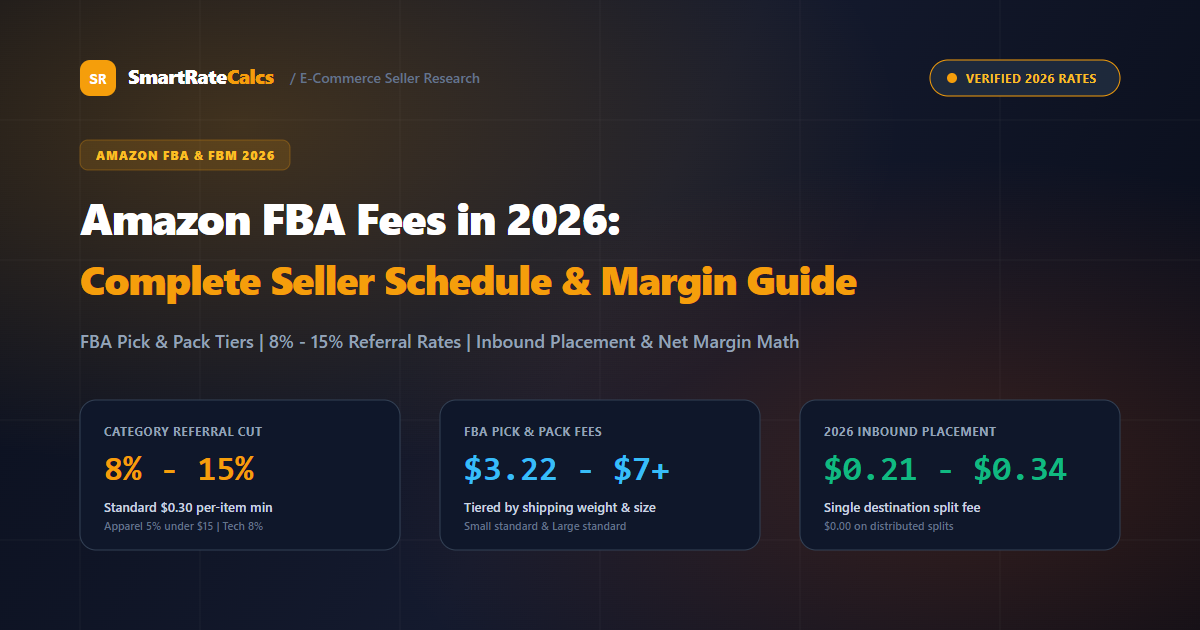
In 2026, Amazon sellers incur a Category Referral Fee of 8% to 15% on gross sales (min $0.30 per item) alongside fulfillment costs. Under FBA (Fulfilled by Amazon), sellers pay weight-tiered Pick & Pack fees ($3.22 to $6.59+ for standard sizes), Inbound Placement fees ($0.21 to $0.34 per unit for single-destination splits), and monthly inventory storage ($0.78/cu ft Jan-Sep, $2.40/cu ft Q4 peak). Under FBM (Fulfilled by Merchant), sellers avoid FBA placement and storage fees but absorb direct carrier postage and customer returns.
Model FBA Pick & Pack, 8% to 15% referral rates, inbound placement, and net margins.
Compare Amazon take rates against eBay 13.25% + $0.30 Managed Payments.
Audit handmade and vintage margins against Amazon Handmade 15% fee structure.
Calculate 15.3% self-employment tax, Schedule C COGS write-offs, and estimated taxes.
Table of Contents
- 1. How Amazon Seller Fee Architecture Works in 2026
- 2. The 4 Core Amazon Fee Layers (Referral, Pick & Pack, Inbound, Storage)
- 3. Complete 2026 Category Referral Fee Matrix Table
- 4. FBA Pick & Pack Tier Schedule (Small Standard, Large Standard, Oversize)
- 5. The 2026 Inbound Placement Fee & Low-Inventory Fee Mechanics
- 6. FBA vs FBM: The Real Mathematical Breakeven Case Study
- 7. The Exact Reverse Pricing & Break-Even Formula
- 8. IRS Form 1099-K Tax Compliance & COGS Deductions
- 9. Frequently Asked Questions
1. How Amazon Seller Fee Architecture Works in 2026
Selling products on Amazon offers unmatched global reach with over 300 million active customer accounts, but navigating Amazon's financial infrastructure requires rigorous accounting precision. Unlike flat-rate platforms like Etsy (6.5%) or Depop (0% selling fee), Amazon utilizes a modular, multi-tiered fee structure where platform take-rates frequently fluctuate between 15% and 35% of gross revenue depending on product dimensions, category classification, and fulfillment method.
Under the modern 2026 Amazon fee framework, every seller must master two primary operational rails:
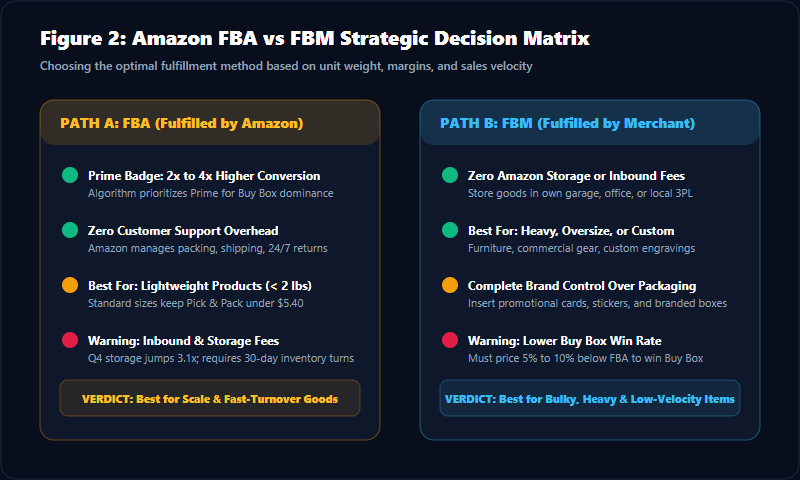
- FBA (Fulfilled by Amazon): Sellers ship bulk inventory to Amazon regional fulfillment centers (FCs). Amazon stores inventory, provides the coveted Prime badge, packs orders, handles 2-day delivery, and manages 24/7 customer service and product returns. In exchange, sellers pay Category Referral Fees, FBA Pick & Pack fees, Inbound Placement fees, and monthly storage charges.
- FBM (Fulfilled by Merchant): The merchant stores inventory in their own facility, packages individual customer orders, purchases carrier postage labels (USPS, UPS, FedEx, Royal Mail), and handles all customer inquiries. In exchange, sellers pay only the Category Referral Fee to Amazon, avoiding FBA logistics overhead.
To calculate your exact net margins and compare FBA vs FBM payouts in real-time, use our live interactive Amazon FBA & Seller Fee Calculator (2026) or audit multi-channel margins against our eBay Fee Calculator and Etsy Fee Calculator.
2. The 4 Core Amazon Fee Layers (Referral, Pick & Pack, Inbound, Storage)
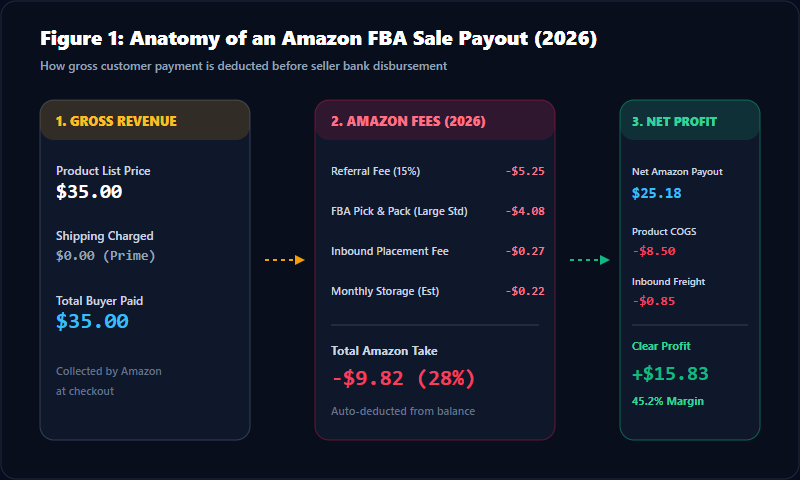
Every Amazon settlement report breaks down into four essential deduction categories. Understanding where each dollar goes is critical to protecting your net margins:
A. Category Referral Fee (8% - 15%)
The primary marketplace commission deducted on every transaction. Amazon assesses this percentage on the total sales amount paid by the buyer (product price + shipping fee charged + gift wrap). Most standard categories (Home, Kitchen, Toys, Sports) incur a flat 15.0% cut, while Consumer Electronics charges 8.0%, and Apparel charges a tiered rate starting at 5.0% under $15.00. Standard minimum referral fee is $0.30 per item ($0.25 in UK).
B. FBA Fulfillment Fee (Pick & Pack)
If utilizing FBA, Amazon charges a unit-level fulfillment fee to pick your item from the warehouse shelf, box it, and ship it to the customer. This fee is calculated strictly by packaged unit size tier (Small Standard, Large Standard, Oversize) and shipping weight, ranging from $3.22 for lightweight 4 oz goods up to $6.59+ for 3 lb items.
C. 2026 Inbound Placement Service Fee
Introduced to reflect the cost of distributing inventory closer to shoppers, this fee applies when creating FBA inbound shipping plans. Sellers shipping to a single receiving center incur $0.21 to $0.34 per unit for standard sizes. Sellers who split their shipments across 4 or more regional facilities pay $0.00.
D. Monthly Inventory Storage Fees
Amazon charges monthly storage fees based on the daily average volume of cubic feet your inventory occupies in fulfillment centers. From January through September, the standard rate is $0.78 per cubic foot. During the Q4 holiday peak (October through December), the rate surges by 3.1x to $2.40 per cubic foot.
3. Complete 2026 Category Referral Fee Matrix Table
Because Amazon adjusts referral rates based on prevailing margins across retail industries, selecting the accurate product category is paramount. Below is the comprehensive 2026 referral schedule for US sellers:
| Category | Referral Fee Rate | Applicable Price Thresholds | Per-Item Min |
|---|---|---|---|
| Home, Kitchen, Toys & Sports | 15.00% | Flat across entire selling price | $0.30 |
| Apparel & Clothing | 5.0% / 10.0% / 17.0% | 5% under $15, 10% ($15-$20), 17% over $20 | $0.30 |
| Computers & Consumer Electronics | 8.00% flat | Flat across total order volume | $0.30 |
| Electronics Accessories | 15.00% / 8.00% | 15% on first $100, 8% on portion over $100 | $0.30 |
| Beauty & Personal Care | 8.00% / 15.00% | 8% on items under $10, 15% on items over $10 | $0.30 |
| Grocery & Gourmet Food | 8.00% / 15.00% | 8% on items under $15, 15% on items over $15 | $0.30 |
| Books, DVDs & Music | 15.00% + $1.80 | 15% plus mandatory $1.80 Closing Fee | $0.30 |
| Jewelry | 20.00% / 5.00% | 20% on first $250, 5% on portion over $250 | $0.30 |
| Automotive & Powersports | 12.00% | Flat across all prices | $0.30 |
4. FBA Pick & Pack Tier Schedule (Small Standard, Large Standard, Oversize)
FBA Fulfillment Fees are governed by physical dimensional thresholds and unit shipping weights. The difference between crossing from Small Standard into Large Standard can cost you over $0.80 per unit in pure margin:
| Size Tier | Max Dimensions | Shipping Weight | 2026 US FBA Fee | 2026 UK FBA Fee |
|---|---|---|---|---|
| Small Standard | 15" x 12" x 0.75" | ≤ 4 oz | $3.22 | £1.65 |
| Small Standard | 15" x 12" x 0.75" | 4 to 8 oz | $3.40 | £1.95 |
| Large Standard | 18" x 14" x 8" | ≤ 4 oz | $3.86 | £2.40 |
| Large Standard | 18" x 14" x 8" | 4 to 8 oz | $4.08 | £2.65 |
| Large Standard | 18" x 14" x 8" | 12 to 16 oz | $5.40 | £3.20 |
| Large Standard | 18" x 14" x 8" | 1.5 to 2.0 lb | $6.10 | £3.95 |
| Small Oversize | > 18" on longest side | Up to 70 lb | $9.73 + $0.42/lb | £6.85 |
5. The 2026 Inbound Placement Fee & Low-Inventory Fee Mechanics
Sellers navigating Amazon in 2026 must account for two major operational updates introduced to penalize inefficient inventory management:
Rule 1: Inbound Placement Service Fee Optimization
When creating a shipping workflow in Seller Central, you are presented with shipment split options. If you choose Minimal Inbound Shipment Split (shipping all pallets or cartons to a single warehouse like ONT8 or FTW1), Amazon charges an Inbound Placement Fee of $0.21 to $0.34 per unit.
Optimization Strategy: If your monthly volume exceeds 1,000 units, selecting Amazon-Optimized Inbound (4+ destinations) completely eliminates this placement fee ($0.00/unit), potentially saving you $3,000+ annually across your catalog.
Rule 2: Low-Inventory-Level Fee Defense
Amazon penalizes products with consistently low stock relative to sales velocity. If your inventory levels drop below 28 days of historical sales relative to both your 30-day and 90-day trailing sales, Amazon assesses a Low-Inventory-Level Fee ranging from $0.32 to $0.89 per unit sold.
To defend against this fee, maintain between 35 and 55 days of supply in FBA, balancing storage expenses against stockout penalties.
6. FBA vs FBM: The Real Mathematical Breakeven Case Study
Consider a real-world product example: a 12 oz silicone kitchen spatula set sold for $29.99. Below is the side-by-side financial settlement comparison:
| Cost Line Item | FBA (Prime) | FBM (Merchant) | Variance / Impact |
|---|---|---|---|
| Listing Price | $29.99 | $29.99 | $0.00 |
| Product Acquisition (COGS) | -$6.00 | -$6.00 | Identical unit cost |
| Amazon Referral Fee (15%) | -$4.50 | -$4.50 | Identical category rate |
| Fulfillment / Shipping | -$4.75 (FBA Pick & Pack) | -$5.80 (USPS Ground Adv) | FBA saves $1.05 on shipping |
| Inbound Placement & Storage | -$0.49 ($0.27 + $0.22) | $0.00 | FBM avoids placement fees |
| Packaging Materials (Box/Tape) | $0.00 (Handled by FBA) | -$0.85 | FBA covers packaging |
| Net Cash Profit | +$14.25 (47.5%) | +$12.84 (42.8%) | FBA earns +$1.41 more profit |
7. The Exact Reverse Pricing & Break-Even Formula
To ensure every SKU launched on Amazon yields an acceptable return on capital, professional sellers use this linear reverse pricing formula. It calculates the minimum required listing price for any target net margin:
TotalUnitFixedCosts = UnitCOGS + InboundFreight + FBAPickAndPack + PlacementFee + MonthlyStorage + ClosingFee
RequiredListingPrice = (TotalUnitFixedCosts + DesiredNetDollarProfit) / (1 - CategoryReferralRate)
TargetNetMarginPercentage = (DesiredNetDollarProfit / RequiredListingPrice) * 100
Our built-in Reverse Target Mode executes this equation dynamically, allowing you to establish exact inventory breakevens before purchasing stock.
8. IRS Form 1099-K Tax Compliance & COGS Deductions
Under current IRS reporting guidelines for 2026, Amazon issues an IRS Form 1099-K to all US sellers who generate more than $5,000 in gross processing volume during the calendar year (subject to state-specific rules enforcing $600 thresholds in MA, MD, VA, and VT).
Crucial tax mechanics to remember:
- Gross Volume vs Taxable Profit: Box 1a of Form 1099-K reports gross transactions before any Amazon referral fees, FBA fulfillment charges, product refunds, or advertising ad spend are deducted.
- Schedule C Write-Offs: You only pay income and self-employment taxes on your net business profit. You deduct all Amazon selling fees, warehouse storage, inbound freight, product acquisition costs, and Amazon Ads PPC spend as legitimate business expenses.
To model your self-employment tax burden and quarterly estimated safe-harbor payments, use our dedicated 1099 Tax Calculator.
Run the Exact Live Calculation
Calculate your personal invoice payout, compare platform deductions, and eliminate hidden currency conversion spreads.
8. Frequently Asked Questions
Q1What percentage does Amazon take from sellers in 2026?
Amazon takes a Category Referral Fee ranging between 8% and 15% on gross sales with a standard $0.30 minimum fee. In addition, FBA sellers pay weight-tiered Pick & Pack fees ($3.22 - $6.59+), Inbound Placement fees ($0.21 - $0.34), and monthly inventory storage.
Q2How does the Amazon Inbound Placement Fee work in 2026?
When creating an FBA shipping plan, sellers who direct inventory to a single receiving warehouse pay between $0.21 and $0.34 per unit for standard sizes. Sellers who split their shipments across 4 or more regional facilities simultaneously avoid this fee entirely ($0.00).
Q3Is Amazon FBA more profitable than FBM?
For lightweight products under 2 lbs, FBA is typically more profitable because Amazon discounted carrier rates beat standard USPS/UPS rates, while conferring the Prime badge to boost conversion by 2x to 4x. For bulky or slow-moving items, FBM is often cheaper because it avoids FBA storage and placement surcharges.
Q4How much are Amazon monthly storage fees in Q4?
Standard monthly storage is $0.78 per cubic foot from January through September. During the Q4 holiday peak (October through December), the rate surges by approximately 3.1x to $2.40 per cubic foot.
Q5When does Amazon issue Form 1099-K to sellers in 2026?
Under current IRS transition rules for 2026, Amazon issues Form 1099-K to US sellers who exceed $5,000 in gross processing volume during the calendar year, though states like MA, MD, VA, and VT enforce lower $600 thresholds.
- •Amazon Seller Central Official Referral Fee Schedule (2026)[External Verified →]
- •Amazon FBA Fulfillment Fee Schedule and Size Tiers[External Verified →]
- •IRS Form 1099-K Information for Third-Party Settlement Orgs[External Verified →]
Muhammad Naveed
Full-Stack and Automation Engineer specializing in cross-border fintech architectures, automated forex modeling, and developer payout infrastructure.