Pakistan Freelancer Tax: 0.25% FBR Section 154A Guide
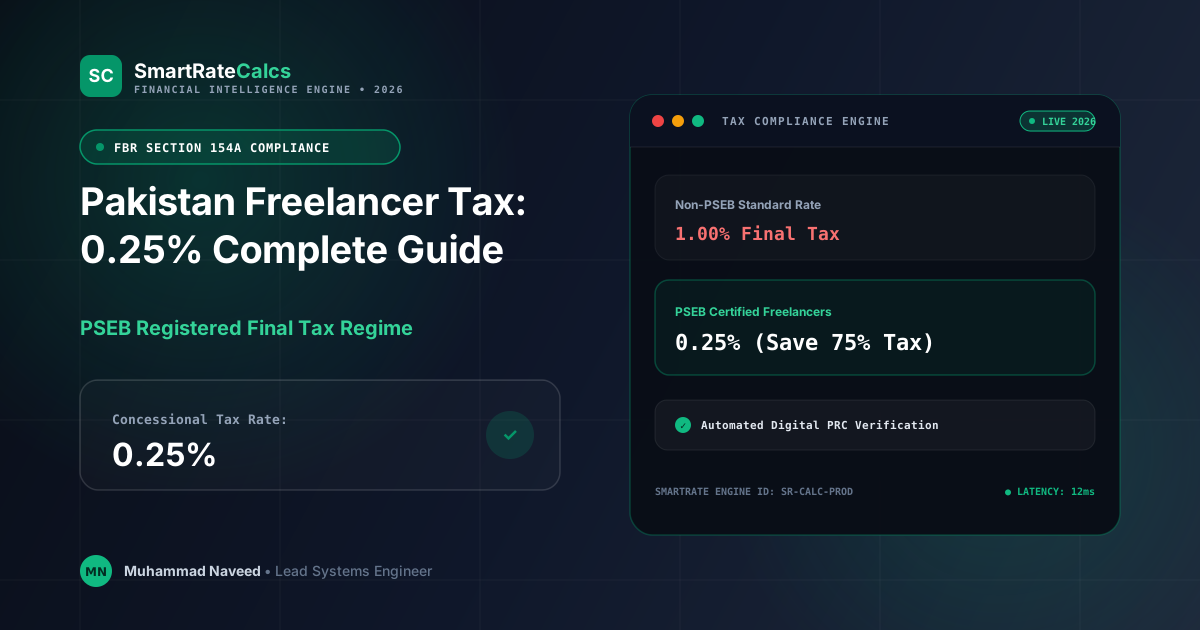
Under FBR Income Tax Ordinance Section 154A, Pakistani freelancers and IT exporters registered with the Pakistan Software Export Board (PSEB) pay a final, non-adjustable tax of just 0.25% on their foreign remittance proceeds. Active filers without PSEB pay 1.0%, while non-filers face penalties and up to 2.0% to 5.0% deductions.
Table of Contents
1. The 3 Tax Tiers for Freelancers: 0.25% vs 1% vs Non-Filer
One of the biggest misconceptions among Pakistani remote developers, designers, and digital marketers is that IT export income is completely tax-exempt. While full tax holidays expired in 2021, the government introduced a highly concessional tax framework under Section 154A of the Income Tax Ordinance, 2001.
You can calculate your exact withholding tax deduction using our free Pakistan Freelancer Withholding Tax (WHT) Calculator. Here are the three distinct legal tax brackets governing remote earners today:
Active Taxpayer on FBR ATL + Valid PSEB Freelancer Registration. Deducted at source by the bank as full and final discharge of tax liability.
Active filer on FBR ATL list, but lacking valid PSEB registration. Commercial bank deducts 1.0% upon foreign currency realization.
Inactive taxpayer or unregistered individual. Subject to severe banking withholding taxes, cash withdrawal penalties, and audit notices.
2. Step-by-Step PSEB Registration for Remote Developers
Registering with the Pakistan Software Export Board (PSEB) takes less than 30 minutes online and costs approximately Rs. 4,000 to Rs. 5,000 PKR annually. It pays for itself on your very first invoice:
- Visit the official portal at pseb.org.pk and create an individual freelancer profile.
- Upload your CNIC, active bank account maintenance certificate, and proof of freelance activity (e.g. Upwork/Fiverr profile URL, active client contracts, or software development invoices).
- Pay the annual government voucher via 1-Link mobile banking or credit card.
- Download your official PSEB Freelancer Certificate (PDF with cryptographic QR verification) within 3 to 5 business days.
- Submit a copy of your certificate to your bank foreign exchange department to lock in your 0.25% deduction rate under Section 154A.
3. What is a PRC and Why is it Critical for FBR Clearance?
A Proceeds Realization Certificate (PRC) is an official document issued by your commercial bank confirming that foreign currency was legitimately converted into Pakistani Rupees under an approved State Bank purpose code (e.g. 9182 for IT services).
When filing your annual wealth statement in FBR Iris, PRCs serve as irrefutable legal proof that your funds originated from foreign IT exports and are fully eligible for final tax treatment. Without PRCs, tax officers can treat foreign deposits as unexplained local income subject to standard income tax slabs up to 35%.
4. How to File Your Annual Income Tax Return in Iris
Under the Final Tax Regime (FTR), filing your annual tax return takes only a few minutes in FBR Iris:
- Declare total gross foreign export proceeds under the Section 154A final tax schedule.
- Enter the exact withholding tax amount already deducted by your bank (0.25% or 1.0%).
- Reconcile the net inflow in your Wealth Statement (Form 116) against personal savings and assets.
- Because Section 154A is a Final Tax, no additional tax is owed, and no complex audit books are required.
Run the Exact Live Calculation
Calculate your personal invoice payout, compare platform deductions, and eliminate hidden currency conversion spreads.
Frequently Asked Questions
Does 0.25% tax apply to Upwork and Fiverr income?
Yes, earnings from IT-enabled services (software engineering, UI/UX design, QA, digital marketing) qualify under Section 154A.
Can banks audit my previous freelance income?
If you file annual tax returns and hold bank-issued PRCs, your export proceeds are treated as final tax and protected from arbitrary audits.
Do I need a business NTN or personal NTN for freelance tax filing?
Individual freelancers can file using their 13-digit CNIC as their personal NTN without registering a separate business entity.
Muhammad Naveed
Full-Stack and Automation Engineer specializing in cross-border fintech architectures, automated forex modeling, and developer payout infrastructure.