Reverb Seller Fees in 2026: 5% Cap, 3.19% Processing & Net Gear Profit Guide
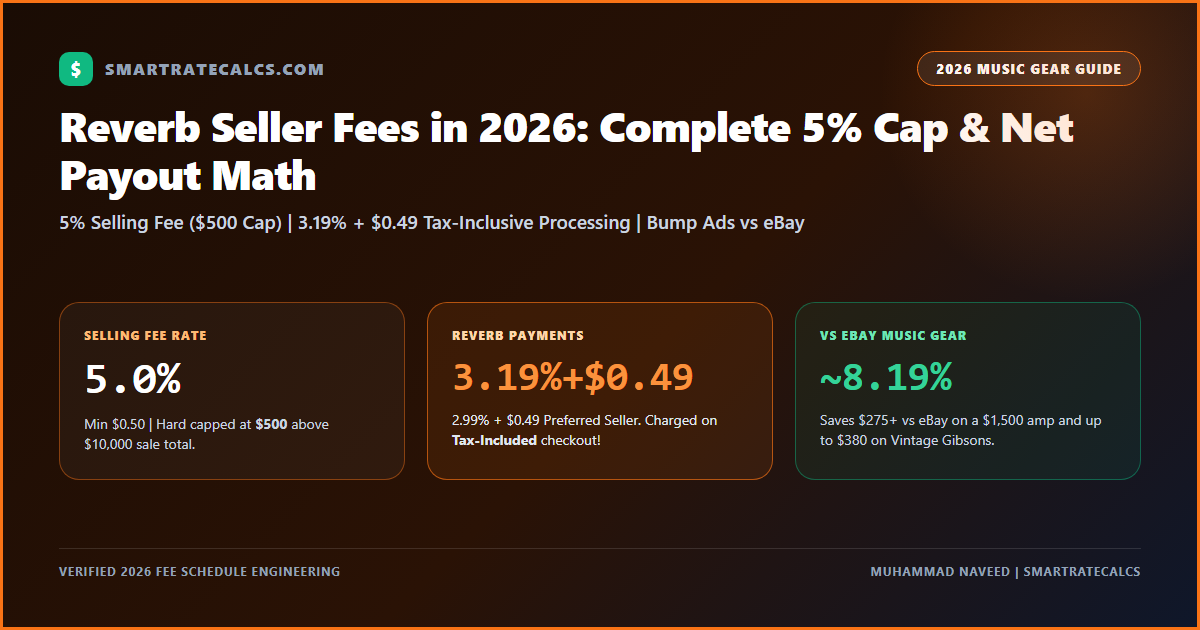
In 2026, selling musical gear on Reverb carries two core platform deductions: a flat 5.0% selling fee applied to Item Price plus Buyer-Paid Shipping ($0.50 minimum and a hard $500.00 cap at $10,000+), plus a Reverb Payments processing fee of 3.19% + $0.49 (or 2.99% + $0.49 for Preferred Sellers) applied to the entire buyer checkout total including state sales tax. With zero Reverb Bump boost, a typical US seller keeps roughly 91.5% to 92.0% of their sale before shipping label costs and cost of goods sold, making Reverb dramatically cheaper than eBay Standard (13.6%+) for amplifiers, synths, studio outboard gear, and pro audio.
Table of Contents
- 1. Executive Overview: How Reverb Fee Layers Stack in 2026
- 2. The 5.0% Selling Fee & The High-Ticket $500.00 Cap Rule
- 3. Reverb Payments (3.19% + $0.49) & The Sales Tax Bleed Trap
- 4. Preferred Seller 2.99% Break-Even & Reverb Bump Ad Math
- 5. Free Shipping vs Separate Buyer-Paid Shipping on Reverb
- 6. Exact Reverse Target Price Formula (Hit Exact Net Payouts)
- 7. Complete 2026 Reverb Payout Schedule ($50 to $15,000 Gear)
- 8. Head-to-Head: Reverb vs eBay Guitars vs eBay Pro Audio vs Sweetwater
- 9. Worked Studio Flipper Case Study: $1,850 Tube Amp Margin Audit
- 10. Frequently Asked Questions
1. Executive Overview: How Reverb Fee Layers Stack in 2026
If you buy, flip, or run an independent music store selling guitars, analog synthesizers, pedals, tube amplifiers, or studio rack gear, understanding every basis point of Reverb seller fees in 2026 is the difference between a profitable boutique gear operation and bleeding 15% of your margin on unmodeled checkout taxes, Reverb Bump ad bids, and oversized parcel surcharges.
While casual musicians routinely quote Reverb's headline "5% selling fee," actual net deposits hit your checking account only after up to four distinct fee layers settle: (1) the core 5.0% Selling Fee, (2) Reverb Payments processing at 3.19% + $0.49 (or 2.99% + $0.49 for Preferred Sellers), (3) optional Reverb Bump sponsored placement fees, and (4) optional 1.0% Cross-Border Currency Conversion. Even more critically, payment processing runs against a larger mathematical base than the 5.0% selling fee because US marketplace facilitator state sales tax is included inside card processing totals.
Switch seamlessly between Forward Payout Mode and Reverse Target Price Solver.
2. The 5.0% Selling Fee & The High-Ticket $500.00 Cap Rule
Reverb keeps its base marketplace commission straightforward compared to general retail sites. Every item sold incurs a flat 5.0% Reverb Selling Fee calculated across the combined total of Item Sale Price + Buyer-Paid Shipping. Reverb enforces two boundary guards around this calculation:
- Minimum Fee Floor ($0.50): On ultra-cheap accessories under $10.00 (such as single patch cables, picks, or plastic knobs), Reverb charges a minimum $0.50 selling fee even if 5% would equal $0.25 or $0.35. Bundling low-ticket studio cables into multi-packs protects profit.
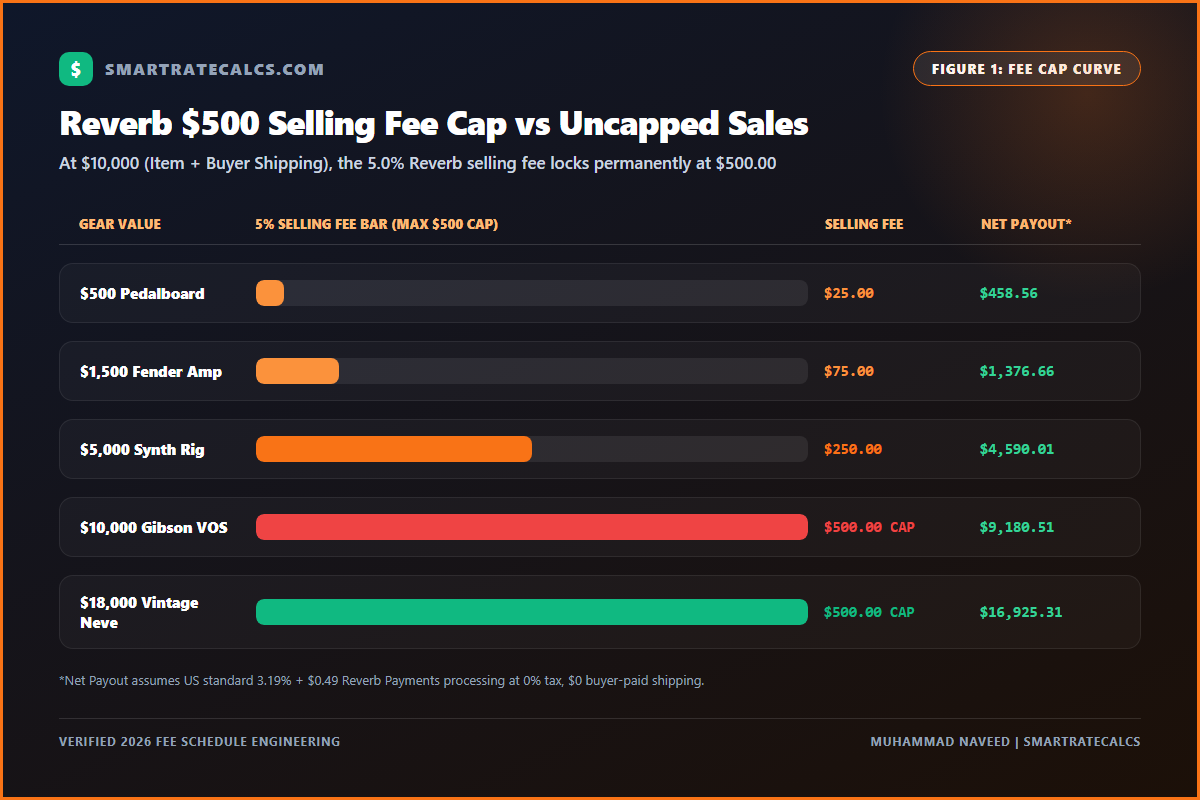
- Maximum Selling Fee Ceiling ($500.00): Reverb strictly caps the 5.0% selling fee at $500.00 per unit sold. Because 5% of $10,000.00 equals exactly $500.00, any high-ticket vintage guitar, custom-shop Les Paul, concert grand piano, or boutique analog mixing console above $10,000 experiences zero additional selling fee growth. Selling an $18,000 vintage Neve preamp or 1959 Gibson ES-335 incurs the exact same $500 selling fee as a $10,000 item, saving sellers $400+ in platform commission compared to uncapped marketplaces.
One subtlety sellers frequently miss: the $500 cap applies strictly to the 5.0% Reverb Selling Fee. Reverb Payments processing (3.19% or 2.99%) has no dollar ceiling and scales linearly across the entire card authorization amount.
3. Reverb Payments (3.19% + $0.49) & The Sales Tax Bleed Trap
If you ask seasoned guitar flippers why their Reverb deposit arrived $4 to $8 lighter than their spreadsheet forecast, nine times out of ten the culprit is sales tax inside Reverb Payments processing.
Under US Marketplace Facilitator tax laws, Reverb automatically collects state and local sales tax (ranging from 0% in Delaware/Oregon up to 9.5% to 10.25% in California, Illinois, or Tennessee) directly from the buyer at checkout and remits it to state tax authorities. However, the underlying credit card and PayPal merchant networks charge Reverb based on the entire funds captured. As a result, Reverb applies its 3.19% + $0.49 standard payment fee (or 2.99% + $0.49 Preferred Seller fee) against:
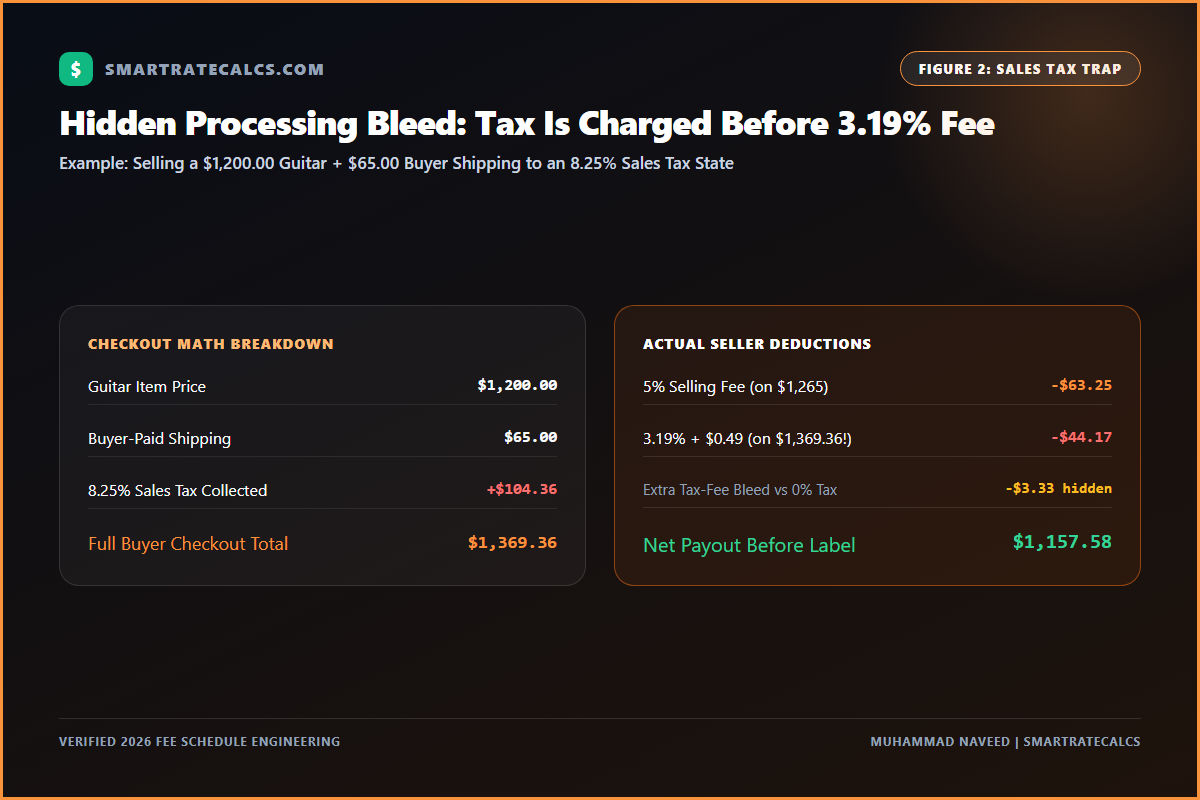
Consider selling a $1,200.00 American Vintage Telecaster with $65.00 buyer-paid insured UPS Ground shipping to a buyer in Austin, Texas (8.25% sales tax):
- 5.0% Selling Fee Base:
$1,200.00 + $65.00 = $1,265.00→ Selling Fee = $63.25. - State Sales Tax Collected:
$1,265.00 × 0.0825 = $104.36. - Card Processing Base:
$1,265.00 + $104.36 = $1,369.36. - 3.19% + $0.49 Processing Fee:
($1,369.36 × 0.0319) + $0.49 = $44.17.
Notice what happened: at 0% sales tax, processing would have been $40.84. Because Texas charged 8.25% tax, you paid $3.33 in extra processing commission on tax dollars you never kept. Always model a realistic 7.0% to 8.0% national average sales tax inside your pricing buffer using our Reverb Fee Calculator so high-tax California or New York checkouts never eat into your net margin.
4. Preferred Seller 2.99% Break-Even & Reverb Bump Ad Math
Beyond the two mandatory deductions, active Reverb shops must optimize two operational levers: achieving Preferred Seller status and deciding when (or whether) to enable Reverb Bump.
Preferred Seller shops earn a 20-basis-point processing discount (dropping from 3.19% to 2.99% + $0.49) alongside earlier Reverb Payments payouts. On $50,000 in annual guitar and pedal turnover (assuming ~7% blended sales tax), that 0.20% savings generates roughly $107 in pure bottom-line cash back straight to your bank account with zero extra ad spend. To hold the badge, ship every order with valid carrier tracking within 2 business days and keep your order defect rate near zero.
The Reverb Bump Reality Check: Reverb Bump allows sellers to bid an optional percentage (typically 1.0% minimum up to 10%+) for prioritized placement in search grids and Reverb's "Price Drop" buyer notifications. Unlike pay-per-click Google Ads, Bump fees are only assessed if a buyer clicks your promoted unit (or purchases within the attribution window) and checks out. However, Reverb calculates your Bump percentage against Item Price + Buyer-Paid Shipping - the exact same base as the 5% selling fee!
5. Free Shipping vs Separate Buyer-Paid Shipping on Reverb
A persistent resale myth suggests sellers can dodge marketplace fees by charging a low item price paired with an inflated $75.00 shipping charge. Reverb closed that loophole years ago: both the 5.0% selling fee and the 3.19% processing rate assess the sum of Item Price + Buyer-Paid Shipping equally.
Still, how you buy the actual shipping label drastically changes net profit. Heavy tube combos (Fender Twin Reverb, Mesa Boogie Mark V) and double-boxed 48-inch guitar cartons frequently hit dimensional weight surcharges on UPS Ground and FedEx Home Delivery. Using Reverb Shipping Labels unlocks commercial discounted UPS and USPS rates alongside Reverb Safe Shipping protection, which insulates you against transit damage claims for a modest flat protection rate. Compare your Reverb Safe Shipping quote against commercial Pirate Ship UPS Ground rates before generating a label for anything heavier than 15 lbs.
6. Exact Reverse Target Price Formula (Hit Exact Net Payouts)
Suppose you bought an Elektron Digitakt or Fender Stratocaster for $650.00, expect to pay $38.00 for your shipping box and UPS label, and refuse to sell unless you walk away with $750.00 in cash profit + recovery (so you need $788.00 net after Reverb fees, assuming $0 separate buyer shipping and 7% estimated buyer sales tax). How do you solve for the exact listing price P?
Never multiply $788.00 by 1.0844. Because fees apply to the higher final price itself, you must solve using algebraic reverse gross-up math:
Plugging in our numbers (Target = $788.00, 0% Bump, 3.19% processing, 7% estimated tax):
- Effective processing rate with 7% tax =
0.0319 × 1.07 = 0.034133(3.4133%). - Denominator =
1 - 0.05 - 0.034133 = 0.915867. - Numerator =
$788.00 + $0.49 = $788.49. - Required Listing Price =
$788.49 / 0.915867 = $860.92(list at $861.00 Free Shipping).
Verify forward: 5% of $861.00 is $43.05; processing on $921.27 ($861 + 7% tax) is $29.88; $861.00 - $43.05 - $29.88 = $788.07 net payout, leaving $750.07 after your $38 UPS label. When gear exceeds the $10,000 selling fee cap, swap the dynamic 0.05 percentage out for a fixed +$500.00 inside the numerator! Our Reverb Reverse Pricing Solver performs that piecewise $500-cap branch switch automatically.
7. Complete 2026 Reverb Payout Schedule ($50 to $15,000 Gear)
The table below models real-world 2026 US Reverb net payouts assuming 0% Bump Ads, standard 3.19% + $0.49 processing, Free Shipping, and a realistic 7.0% national average sales tax collected at checkout:
| Gear Sale Price | 5% Selling Fee | Processing (3.19%+$0.49 on +7% Tax) | Total Reverb Fees | Net Payout (Before Label) |
|---|---|---|---|---|
| $50.00 Pedal | $2.50 | $2.20 | $4.70 (9.4%) | $45.30 |
| $200.00 Stompbox | $10.00 | $7.32 | $17.32 (8.7%) | $182.68 |
| $500.00 Synth | $25.00 | $17.56 | $42.56 (8.5%) | $457.44 |
| $1,000.00 Guitar | $50.00 | $34.62 | $84.62 (8.5%) | $915.38 |
| $2,500.00 Tube Amp | $125.00 | $85.82 | $210.82 (8.4%) | $2,289.18 |
| $10,000.00 Vintage | $500.00 (CAP) | $341.82 | $841.82 (8.4%) | $9,158.18 |
| $15,000.00 Custom Shop | $500.00 (CAP) | $512.49 | $1,012.49 (6.7%) | $13,987.51 |
8. Head-to-Head: Reverb vs eBay Guitars vs eBay Pro Audio vs Sweetwater
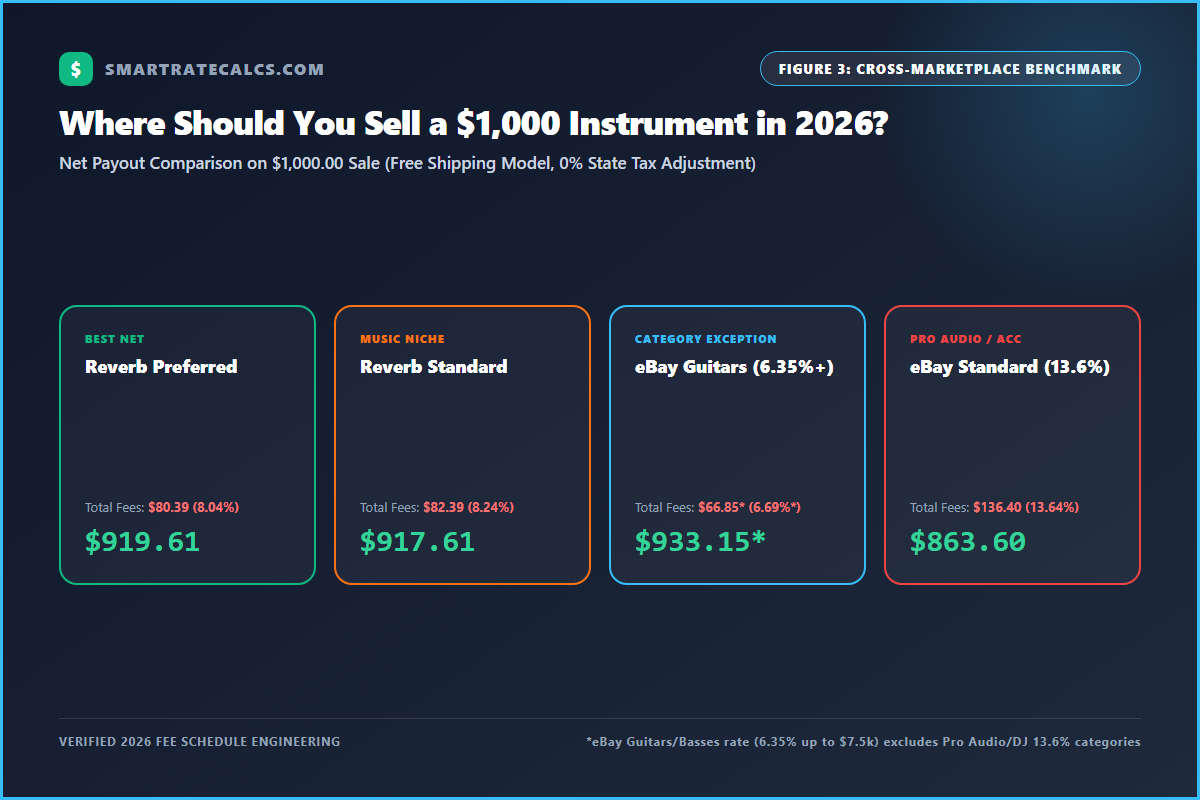
Smart gear dealers never marry a single platform blindly; they match categories to fee schedules. While eBay's general Managed Payments rate charges 13.6% + $0.40 across Pro Audio mixers, microphones, DJ controllers, synthesizers, and effect pedals, eBay carved out a discounted 6.35% tier (up to $7,500) specifically for Musical Instruments → Guitars & Basses in the US.
- For Synthesizers, Eurorack, Pedals, Studio Mics & Amps: Sell on Reverb (~8.4% effective). Listing a $1,500 Prophet synth on eBay Pro Audio costs ~$204 in fees versus ~$126 on Reverb - an instant $78 cash win.
- For Electric & Acoustic Guitars ($500 to $7,500): Run a dual comparison! eBay's special 6.35% Guitar category edge saves roughly $15 to $45 over Reverb if your buyer isn't demanding Reverb's gear-verified buyer pool, though Reverb typically commands stronger closing prices on boutique brands (Suhr, Tom Anderson, Klon, Chase Bliss).
- For Sweetwater Gear Exchange & Local Cash: Sweetwater waives seller fees completely if you take payout as a Sweetwater Gift Card rather than bank ACH (otherwise charging ~7.5% cashout), while verified Venmo Business G&S (1.9% + $0.10) gives local pickup buyers protected checkout at under 2% total cost.
9. Worked Studio Flipper Case Study: $1,850 Tube Amp Margin Audit
Suppose you pick up a used Mesa Boogie Dual Rectifier head locally for $1,200.00 cash, spend $45.00 on fresh 6L6 bias check & double-wall box, and sell it on Reverb for $1,850.00 + $95.00 Buyer Shipping with a 2.0% Reverb Bump bid to a buyer in a 7.5% tax state:
Remember also to track your gross payouts for IRS compliance: if your gross Reverb receipts clear federal or state Form 1099-K reporting thresholds, keeping clean receipts for your $1,200 gear acquisition cost ensures you pay tax strictly on your $408.66 net gain using our 1099-K Self-Employment & Schedule C Calculator.
Run the Exact Live Calculation
Calculate your personal invoice payout, compare platform deductions, and eliminate hidden currency conversion spreads.
Frequently Asked Questions
Q1What percentage does Reverb take in total in 2026?
For a standard US seller without Bump ads, Reverb charges a 5.0% selling fee (on item price plus buyer-paid shipping) plus a 3.19% + $0.49 Reverb Payments fee (on the full checkout total including sales tax). On a $1,000 sale with 7% sales tax, total combined platform fees are $84.62, or roughly 8.46% of your item price before your shipping label cost.
Q2Does Reverb charge its 5% selling fee on state sales tax?
No. Reverb charges the 5.0% selling fee strictly on your Item Price plus any separate Buyer-Paid Shipping charge. However, Reverb Payments (3.19% + $0.49, or 2.99% + $0.49 for Preferred Sellers) IS charged on the entire credit card checkout total, which includes buyer-paid state sales tax.
Q3What is the maximum fee cap on Reverb?
Reverb caps its 5.0% selling fee at $500.00 per item. You hit that ceiling whenever Item Price plus Buyer-Paid Shipping reaches $10,000.00. Above $10,000, the 5% selling fee locks at $500.00 forever, though the 3.19% (or 2.99% Preferred) payment processing fee remains uncapped.
Q4Does offering Free Shipping save money on Reverb fees?
No. Because Reverb applies both the 5.0% selling fee and the 3.19% + $0.49 payment processing fee to Item Price plus Buyer-Paid Shipping combined, listing a pedal for $100 + $10 shipping incurs identical Reverb platform fees as listing it for $110 + Free Shipping.
Q5How do I qualify for the 2.99% Reverb Preferred Seller fee discount?
Reverb grants Preferred Seller status automatically when a shop completes consistent sales volume, ships orders within 2 business days with tracking, maintains a 4.5+ star feedback average, and resolves customer messages promptly. The reward lowers Reverb Payments from 3.19% + $0.49 down to 2.99% + $0.49, saving $2.00 per $1,000 of gross checkout volume.
Q6Can international buyers trigger extra fees on Reverb?
Yes. If you accept a payment requiring cross-border currency conversion outside your native Reverb Payments payout currency, or utilize international payment rails, Reverb applies a 1.0% international FX conversion fee on top of standard selling and processing deductions.
- •Reverb Help Center: What fees will I pay for selling on Reverb?[External Verified →]
- •Reverb Seller Hub: Reverb Preferred Seller Program Benefits[External Verified →]
- •IRS Form 1099-K Payment Settlement Entity Guidance[External Verified →]
Muhammad Naveed
Full-Stack and Automation Engineer specializing in cross-border fintech architectures, automated forex modeling, and developer payout infrastructure.